After enough years hauling roll-offs around Arlington and the rest of Northern Virginia, you start to learn that the question people ask most isn't "how big a dumpster do I need?" It's "can I throw this in there?" Fair question. The honest answer is: most of your junk, yes. Some of it, absolutely not. And a few things will get the whole load rejected at the transfer station and cost you money you weren't planning to spend.
So let me walk you through it the way I'd explain it standing in your driveway. What goes in, what stays out, what needs its own bin, and why the rules are the way they are here in Virginia.
The stuff that goes in without a second thought
A roll-off dumpster is built for volume, and the bulk of what people load is exactly what it's designed for. General household junk is the bread and butter. Think about a garage that hasn't been cleaned out since the Clinton administration, a basement full of boxes, closets stuffed with things nobody's touched in a decade. Bagged trash, old clothes, toys, kitchenware, cardboard, packing material, books, small non-electronic odds and ends. All of it welcome.
Furniture is fine too. Couches, sectionals, recliners, dressers, bed frames, mattresses, box springs, dining sets, desks, bookshelves. A word on mattresses: some Virginia transfer stations charge a small separate fee to process them because they're a pain to shred, so mention it up front when you book and there won't be surprises. But they can go in the box.
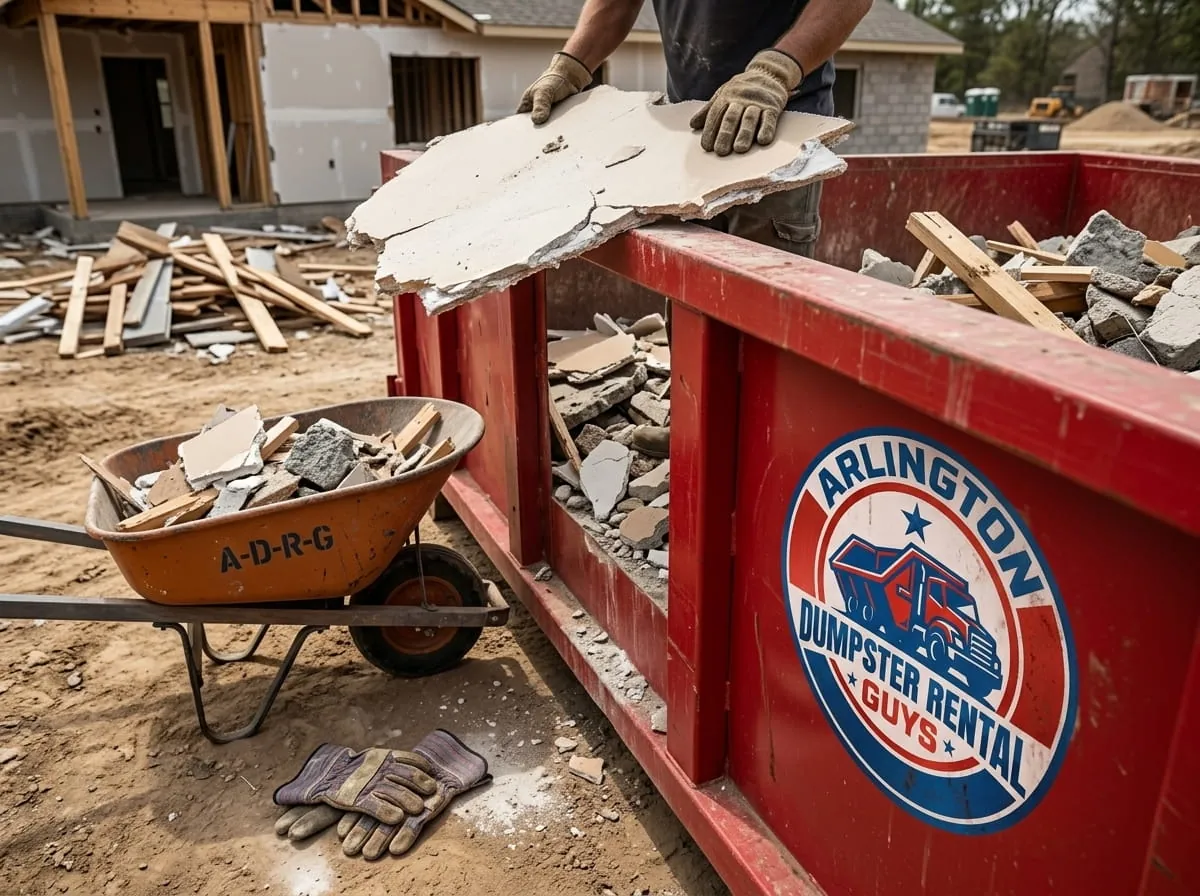
Construction and renovation debris is the other big category, and it's where a lot of our Northern Virginia work lives. Drywall, lumber, plywood, trim, molding, subflooring, laminate, hardwood, carpet and padding, tile (in reasonable amounts), roofing shingles, siding, insulation, cabinets, countertops, doors, windows, fencing, decking boards. If you're gutting a bathroom or reworking a kitchen in an Arlington bungalow, nearly everything that comes off the walls and floors is dumpster-legal.
Yard waste generally counts as well. Branches, brush, leaves, shrubs, small stumps, sod, grass clippings. Here's the catch worth knowing: some facilities want clean organic yard debris kept separate from mixed trash so it can be composted or mulched instead of landfilled. If you've got a big landscaping job that's nothing but green waste, tell us, because a dedicated load often disposes cheaper. Mix a couple bags of leaves in with a household cleanout and nobody blinks.
Where it gets more complicated
Now the flip side. There's a category of materials that are perfectly legal to throw away but are so heavy that they'll blow past a dumpster's weight rating long before the box looks full. Concrete, brick, block, asphalt, stone, pavers, dirt, gravel, sand. This stuff is dense. A little pile that looks like nothing can weigh more than an entire container of household junk.
The reason this matters: every roll-off has a weight limit, and it also has to be safe to lift onto the truck and legal to drive down the road. Overload a 20-yard box with broken-up patio concrete and it becomes a hazard nobody can move. That's why heavy inert material almost always goes in its own dedicated container, usually a smaller 10-yarder rated for the density. If your project involves busting up a driveway, a sidewalk, or a foundation, look at our concrete and heavy debris service instead of trying to cram it in a mixed bin. It's cheaper in the long run and it keeps the load legal.
Same logic applies to clean fill dirt. A yard of soil weighs well over a ton, and wet dirt weighs more. Keep it separate, and keep it clean too, because dirt mixed with roots, trash, or construction debris usually can't be reused as fill and gets treated as regular waste at a higher rate. Roofing shingles are the sleeper in this category. A tear-off doesn't look heavy, but a full roof's worth of old asphalt shingles adds up fast, so we often spec a smaller box for those jobs even though the material itself is accepted.
Give us a call at (571) 583-6105 before you start swinging the sledgehammer, and we'll size the right container for whatever you're tearing out. Two minutes on the phone saves a lot of grief on pickup day.
The hard no list
This is the part to actually pay attention to, because these items aren't a matter of weight or convenience. They're prohibited by state and federal regulation, and putting them in a roll-off can mean rejected loads, contamination fees, or fines that land on the property owner. When a driver hauls a container to a Virginia transfer station and the load fails inspection, that cost comes back around. So here's what stays out, no exceptions.
Hazardous waste of any kind. If a product has a warning label about toxicity, flammability, corrosiveness, or reactivity, treat it as off-limits. That covers a wide net: solvents, thinners, adhesives in bulk, pool chemicals, pesticides, herbicides, fertilizers, cleaning chemicals in quantity, and anything labeled poison or caustic.
Paint, stains, and finishes. Liquid paint is one of the most common mistakes. Latex, oil-based, primer, lacquer, wood stain, sealer. It's considered a hazardous liquid and can't go in the box wet. There's a workaround for latex: if you air-dry it out completely, or harden it with cat litter or a paint hardener until it's a solid brick with no liquid left, dried latex is often acceptable as regular waste. Oil-based paint is stricter and belongs at a hazardous waste facility regardless.
Automotive fluids. Motor oil, transmission fluid, brake fluid, antifreeze, gasoline, diesel. All of it goes to a proper collection point, never the dumpster.
Tires. Virginia specifically bans whole tires from landfills. They trap methane, they float back up through cover soil, and they're a mosquito breeding ground. Tires go to a tire recycler, and most auto shops will take them for a small per-tire fee.
Batteries. Car batteries, lithium-ion packs, rechargeables. Lead-acid car batteries are actually one of the most recycled products in the country, and any auto parts store will take yours. Lithium batteries are a genuine fire risk in a compacting waste stream, so they never belong in a mixed load.
Electronics. Virginia treats e-waste as a separate stream. TVs, monitors, computers, laptops, printers, phones, tablets, stereo gear. Old CRT televisions in particular contain leaded glass and are banned from ordinary disposal. These go to an e-waste recycler, and there are drop-off events and permanent sites across Northern Virginia that take them free or cheap.
Appliances containing refrigerant. Refrigerators, freezers, air conditioners, window units, dehumidifiers, and older water coolers use Freon or a similar refrigerant. Federal law requires that refrigerant be professionally recovered before the appliance is scrapped, because it's a potent greenhouse gas. A fridge with the coils still charged can't just go in the box. Get it evacuated first and certified, or hand it to a hauler set up to handle it. Appliances that never had refrigerant, like washers, dryers, stoves, dishwashers, and water heaters, are usually fine and are often pulled for scrap metal anyway.
A few others worth naming: propane tanks and any pressurized cylinder (they can explode when crushed), asbestos-containing material (which has its own strict abatement rules), medical and biohazard waste, ammunition and flares, and railroad ties or other creosote-treated timber at most facilities. When in doubt, ask before it goes in.
Why Virginia draws these lines
None of this is arbitrary. The state's solid waste program, run under the Department of Environmental Quality, sets what can be landfilled and what has to be diverted. The through-line behind every banned item is the same: it either poisons groundwater, catches fire, off-gasses, or can't safely be compacted and buried. Landfills here are lined and monitored, and keeping the nasty stuff out is what keeps them functioning and keeps disposal costs from spiraling for everyone.
The good news is that Arlington and the surrounding counties make the alternatives easy. There are household hazardous waste drop-offs, e-waste recycling sites, and scrap metal yards within a short drive of just about any neighborhood we serve. You don't have to hoard the banned stuff. You just can't put it in the roll-off.
Not sure? That's what we're here for
Here's the practical rule I give people: if you're staring at something wondering whether it's allowed, it's worth a thirty-second phone call. We'd much rather answer the question up front than have a driver flag it at the curb or the transfer station bounce the whole load. Most cleanouts sort neatly into "goes in the box" and "handle separately," and once you've done it once it's obvious.
If your project is really more of a haul-it-all situation, where you'd rather someone else do the lifting and the sorting, that's a different service. Our junk removal crew handles the load-and-go jobs and knows exactly where each stream needs to end up. And if you already know what you've got and just want the right container dropped in your driveway, reach out and we'll get you set up.
Load it right, keep the banned stuff out, put the heavy inert material in its own bin, and a roll-off does exactly what it's supposed to: makes a big messy job disappear without any drama on pickup day.
Founder, Arlington Dumpster Rental Guys — sharing straight advice from more than 15 years of local hauling experience.