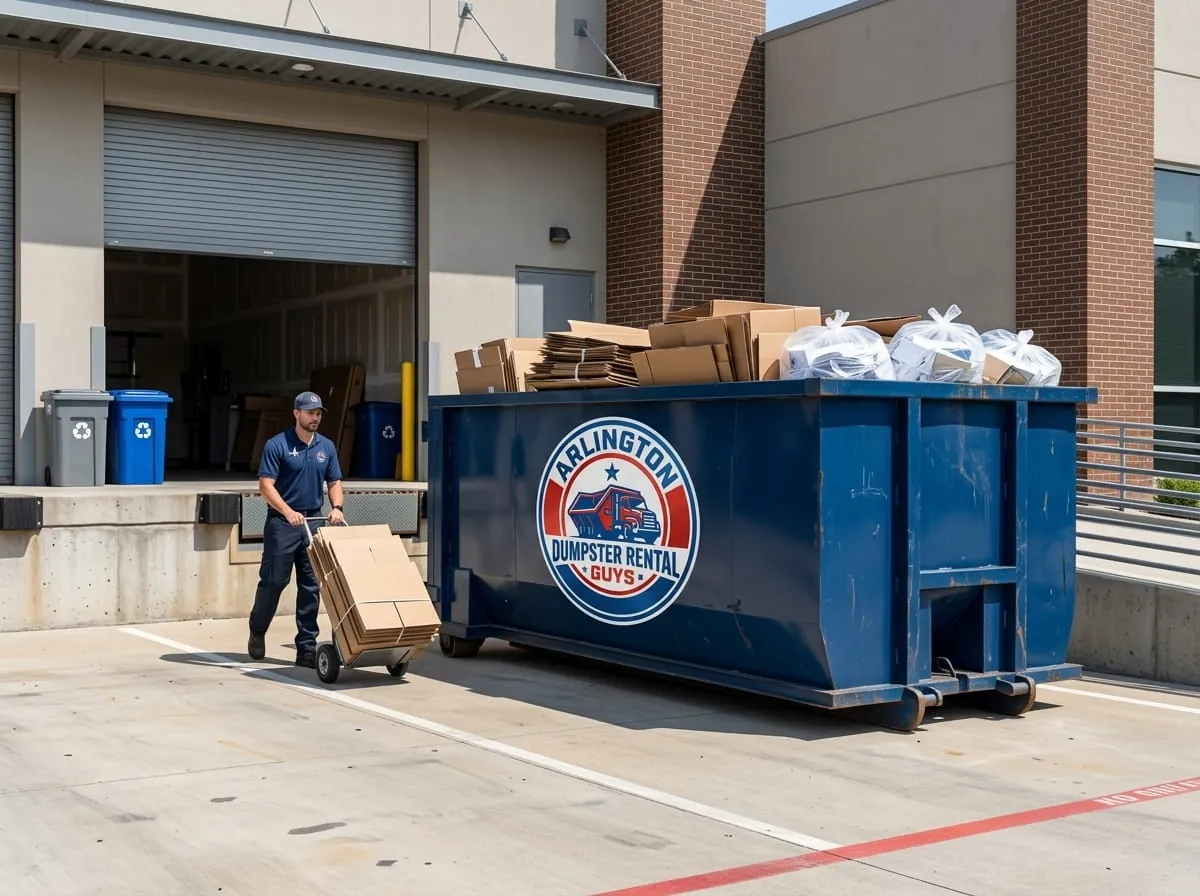
Short version, because that's probably why you're here: if the dumpster sits on your own driveway or private property, you almost never need a permit. If it has to sit on a public street or in the county right-of-way, you almost always do. Everything else is detail. But in Arlington and the denser pockets of Northern Virginia, the details are where people get tripped up, so let's walk through them the way I'd explain it to a neighbor over the fence.
I've been placing roll-off containers around Arlington, Alexandria, Falls Church, and out into Fairfax County for years. The permit question comes up on nearly every call, and the honest answer is: it depends on three things. Where the container goes, who owns or governs the ground it touches, and whether anyone shares that ground with you. Get those three straight and you'll know exactly what you're dealing with.
Driveway and private property: usually no permit
This is the easy case and, thankfully, the most common one. If you own the property and the dumpster fits entirely within your driveway, side yard, or another spot on your own land, Arlington County generally does not require a permit for that. You're using your own private property. No county paperwork, no fees to the county, no waiting on an approval before we can drop the container.
That covers the majority of single-family jobs we do. A kitchen gut, a basement cleanout, a roof tear-off, a garage that hasn't seen daylight since the Clinton administration — in most of those cases we roll up, set the box on your driveway on plywood so it doesn't mark the surface, and you're off to the races.
A few things still matter even on private property. The container has to sit fully on your land, not hanging over the sidewalk or the curb strip. It shouldn't block a shared access easement or your neighbor's ability to get in and out. And if you're in a townhouse or a community with shared drives, "your" driveway may not be as private as it looks — more on that below. But as a rule, driveway placement on a property you own is the path of least resistance, and it's what we steer people toward whenever it's realistic.
Public street or right-of-way: permit required
Now the other case. If there's no room on your property — and in a lot of Arlington neighborhoods with short driveways or no driveway at all, there isn't — the container has to go in the street or along the curb. The moment it touches the public right-of-way, you're in permit territory.
The right-of-way is the strip the county controls: the travel lanes, the parking lane, often the curb strip and sidewalk area too. Arlington County requires an obstruction or use-of-right-of-way permit to place anything in that space, and a roll-off dumpster absolutely counts. The reasoning is straightforward. That container occupies a public parking spot or part of a travel lane, it affects sight lines and traffic flow, and the county wants a record of who put it there, for how long, and whether it's marked and protected properly.
These permits typically come with conditions. You may need reflective markers or cones, the container may need to sit a certain distance from intersections, fire hydrants, and driveways, and there's usually a defined time window. Some placements on busier roads can trigger extra requirements around traffic control. None of it is exotic, but it's real, and skipping it can mean a citation, a fine, or the county telling you to move the box on short notice.
How the Arlington County right-of-way permit process works, in general terms
I'll speak in general terms here on purpose, because the county updates its fees, forms, and turnaround times, and I don't want you acting on a number that changed last quarter. Always confirm the current specifics with Arlington County before you commit to a date.
That said, the shape of the process is consistent. You (or we, on your behalf) apply for a right-of-way or obstruction permit through the county's permitting system. The application asks for the placement location, the size of the container, the dates it'll be out, and sometimes a simple sketch of where it sits relative to the curb and nearby driveways. There's a fee, and there's a review window — this isn't always same-day, so you plan around it rather than deciding at the last minute.
Once approved, the permit usually has to be available on site and the placement has to match what you applied for. If your project runs long, you extend or renew rather than letting it lapse. When the job wraps, the container comes out and the right-of-way goes back to normal.
The single biggest mistake I see: people treat the permit as an afterthought and lose days waiting on approval while their contractor stands around. Build the lead time in. If street placement is even a possibility, start that conversation early.
HOAs, condo associations, and civic covenants
Here's the layer a lot of Arlington and NoVA folks forget, and it bites harder than the county sometimes. Even when the county doesn't require a permit — even when the box is sitting squarely on your own driveway — your homeowners association or condo association may have its own rules, and those rules are enforceable against you.
In the dense parts of Arlington, Ballston, Clarendon, Pentagon City, and the townhouse and condo communities threaded through the county, shared property is the norm. The "driveway" might be a common element. The parking lot is association-controlled. There may be covenants about how long a container can sit out, where it can go, whether it needs to be on boards, and how visible it can be from the street. Some associations want written notice or a formal approval before anything gets dropped.
If you're in a managed community, call your property manager or check your association's rules before you book. It costs you one phone call and can save you a fine or the awkward experience of having a board member ask you to remove a full container on a Saturday. We can work with almost any set of association requirements once we know what they are — the problem is only ever the ones we find out about after delivery.
Not sure which category your project falls into? Call Arlington Dumpster Rental Guys at (571) 583-6105 and we'll walk your address, your placement options, and whether a permit is in the picture — before you're committed to anything.
Tight lots, limited parking, and the reality of Northern Virginia
Arlington is not a place with acres of open driveway. A big share of the county is older homes on compact lots, townhouses with tandem parking, and condos where you don't control any ground at all. That reality shapes the whole permit question.
On a tight lot, container size matters more than people expect. A smaller box like a 20-yard dumpster has a real footprint advantage on a short driveway — it fits where a larger one would hang into the sidewalk or force you onto the street and into permit territory. We'd genuinely rather set you up with the right-sized container that stays on your property than a bigger one that drags you into county paperwork you didn't need. Part of our job is looking at your space honestly and telling you what actually fits.
Delivery access is the other tight-lot reality. Our trucks need swing room and clearance to set and later pick up the container. Low branches, narrow shared lanes, cars parked bumper to bumper, and street-cleaning days all factor in. When you call, tell us about the approach to the spot, not just the spot itself. The more we know up front, the fewer surprises on delivery day. You can see how our roll-off dumpster rental service handles these NoVA placement puzzles as a normal part of the job.
Timelines: plan backward from your project
Time is the thing people underestimate. Here's how I'd think about it.
- Private driveway, no association issues: this can move fast. Often we can schedule delivery within a day or two, sometimes same or next day depending on the calendar.
- Association approval needed: add however long your HOA or condo board takes to say yes. Some are quick; some only meet periodically. Ask early.
- County right-of-way permit needed: add the county's review window on top of scheduling. This is the one that most often stretches a timeline, so if street placement is likely, start days ahead, not hours.
A good rule: figure out your placement first, then work backward. If it's your driveway and no association is involved, you're flexible. If a permit or approval is in the mix, that clock drives your start date, not the other way around.
What we handle, and what stays with you
People ask what we take off their plate. Here's the honest division of labor. We handle sizing the container to your space, protecting your driveway, delivering and positioning the box, and hauling it out when you're done. Where a right-of-way permit is involved, we'll help you understand what's required and coordinate the placement to match it. What we can't do is waive a county rule or an association covenant — those belong to the county and your board, and we all have to play by them.
What stays with you is the local knowledge only you have: which association governs your property, what its rules say, and whether your specific block has quirks. You confirm the current specifics with the right authority — Arlington County for most of Arlington, or the relevant jurisdiction if you're in Alexandria, Falls Church, or Fairfax County, since each runs its own permitting and its own rules. When in doubt, a quick call to the county or town, plus a call to us, covers you completely.
The bottom line
Do you need a permit for a dumpster in Arlington? On your own driveway, usually not. In the public street or right-of-way, almost always. And in the dense, association-heavy neighborhoods that make up so much of Arlington and Northern Virginia, the HOA or condo approval can matter just as much as anything the county requires. Nail down where the box goes and who governs that ground, and the rest falls into place.
If you'd rather not sort it out alone, that's what we're here for. Reach out through our contact page or call and we'll help you figure out the cleanest, most compliant way to get a container on site — permit or no permit.
Founder, Arlington Dumpster Rental Guys — sharing straight advice from more than 15 years of local hauling experience.