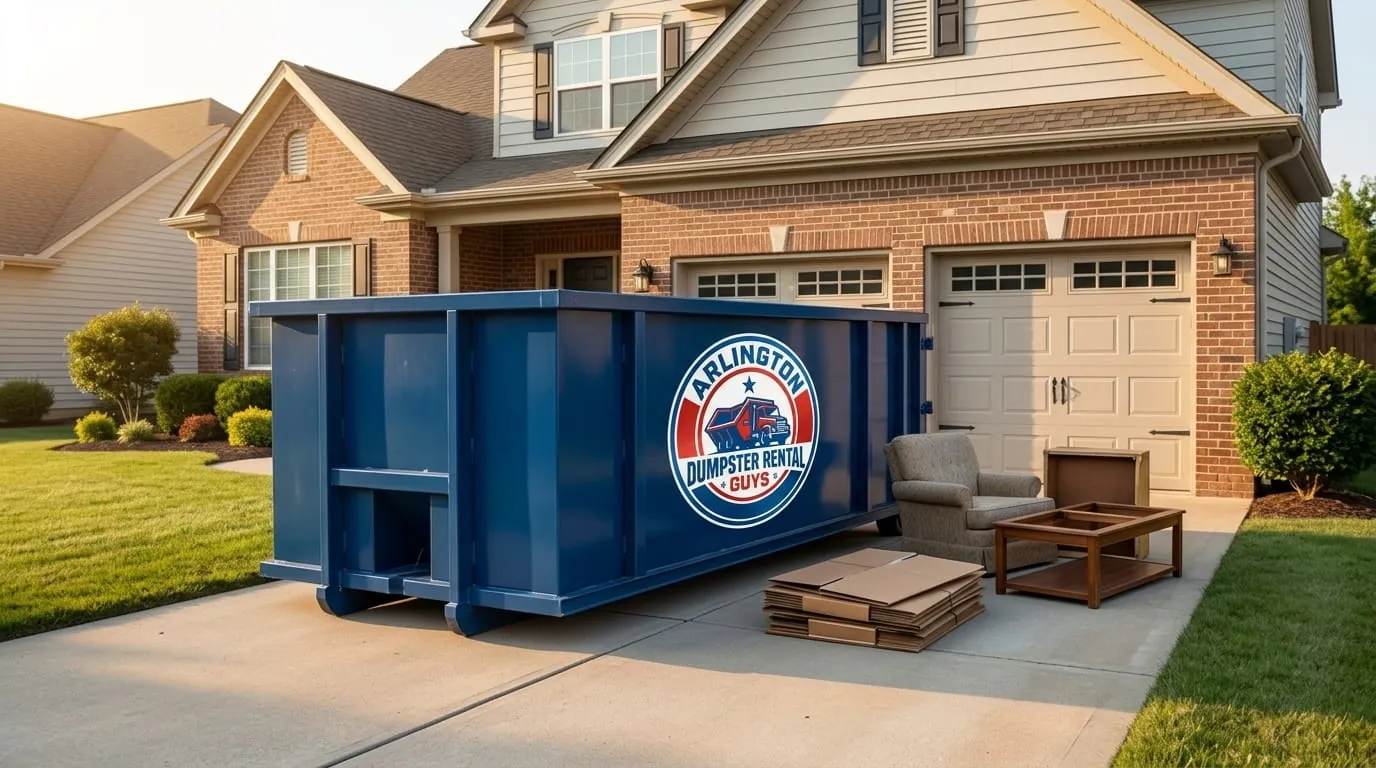
Here is the thing nobody tells you when you book a dumpster: the container itself is the easy part. What can go sideways is the surface you set it on. I have been dropping roll-offs on Arlington driveways for years, and the calls I hate getting are the ones that start with, "There's a crack that wasn't there before." Almost every one of those was avoidable.
A 20-yard roll-off weighs somewhere around 4,000 to 6,000 pounds empty. Fill it with roofing shingles, broken concrete, or wet drywall and you are easily looking at 8, 10, sometimes 12 tons sitting on a footprint smaller than a parking space. That load rides on two steel rails and, during delivery and pickup, rolls across two hard wheels at the back. Your driveway was not designed with that in mind.
Why Driveways Get Damaged in the First Place
Different surfaces fail in different ways, and knowing which one you have tells you how careful you need to be.
Asphalt is the big one around here, and it is the most vulnerable, especially in summer. Asphalt is a flexible pavement, which is a polite way of saying it goes soft when it gets hot. On a 95-degree August afternoon in Arlington, the surface temperature of a black driveway can push past 130. Set two narrow steel rails on that and the container legs sink in like a heel in a lawn. You get permanent dimples, sometimes gouges, and once the top layer is punctured, water gets underneath and the problem grows every winter.
Concrete is tougher but not bulletproof. It handles weight well in compression, but it cracks when the load concentrates on a small area or lands on a spot that already has a hairline flaw. Older Arlington driveways with control-joint cracks are the usual victims. The other concrete issue is staining: hydraulic fluid, rust off the container, or leachate dripping out of a wet load leaves marks that do not scrub off.
Pavers and stamped concrete are the ones that make me nervous. Pavers sit on a sand-and-gravel base, and a heavy point load can push individual pavers down or shift them out of line. Once the pattern is disturbed you are looking at a real repair, not a touch-up. Stamped and decorative concrete has a sealed, sometimes colored surface that scratches and stains easily. If you have either of these, protection is not optional.
The Fix Is Boring and It Works: Put Something Under It
The single most effective thing you can do is spread the load. The container's weight is the same either way, but if you distribute it across a wider area, the pressure on any one point drops dramatically. That is the whole game.
Standard practice is to lay down plywood or planks in two places:
- Under the container's rear legs and rails where it rests for the duration of the rental. Two-by-tens or, better, 3/4-inch plywood sheets stacked two deep work well. You want the boards under every contact point, not just one.
- Along the wheel path where the truck rolls the container off and pulls it back on. This is the moment of highest stress because all the weight is briefly on those two back wheels as the box tilts and rolls. A run of plywood down that path saves the surface from point-load gouging.
Use plywood at least 1/2-inch thick, though 3/4-inch is better for a heavy load. Full sheets beat scraps. If you are protecting asphalt in hot weather, doubling up the plywood under the legs is cheap insurance. And put the boards down before the truck arrives, not after the container is already sitting there, because once it is down it is not moving until pickup.
One more detail people miss: a piece of scrap wood or a rubber mat under the container is also your defense against drips. Roll-offs carry construction debris, and water plus debris equals a rust-and-grime cocktail that stains concrete. A barrier underneath keeps that off your surface.
Placement Matters More Than You Think, Especially in NoVA
Arlington and the inner Northern Virginia neighborhoods were not built for wide driveways. A lot of homes here have narrow, sloped, or short driveways hemmed in by mature trees, retaining walls, and the neighbor's fence three feet away. Where the container goes determines both how much it can damage and how much of a headache the whole rental becomes.
A few things I look at on every drop:
- Pick the flattest spot. On a sloped driveway, a container wants to load unevenly and the downhill legs dig in harder. If your driveway pitches steeply, sometimes the smarter move is the street rather than fighting the grade.
- Mind the overhead. The delivery truck needs clearance to raise its bed, usually more than 20 feet of vertical space. Low tree branches and utility lines are constant obstacles on our older streets. Walk the path before delivery.
- Leave working room. You need to walk around the container to load it, and the doors on the back swing open. Jamming it against the garage might feel tidy but it makes the job miserable.
- Think about the pickup. The truck has to pull straight out. If a parked car, a trash can, or a basketball hoop will be in the way on pickup day, move it now.
For tight lots where the driveway genuinely cannot take a container, the street is often the answer, and that opens up a different set of rules. If you want a hand thinking through the right size and spot for your specific lot, our residential dumpster rental team does this walkthrough on every job.
HOA and Street Permits: Do Not Learn This the Hard Way
This is the part that turns a smooth weekend into a fine or an angry letter. Northern Virginia is dense with HOAs and condo associations, and Arlington County has real rules about the public right-of-way.
HOA rules. Many associations here restrict how long a dumpster can sit, where it can be placed, and whether it needs to be screened from the street. Some require advance notice or a permit from the management company. Check your covenants before you book, not after your neighbor complains. A quick email to your property manager saves everyone grief, and it is a lot easier than explaining a violation after the fact.
Street placement permits. If the container is going on a public street or blocking any part of the public right-of-way, Arlington County generally requires a permit. Placement on your own private driveway usually does not, which is one more reason the driveway is often the simpler option when your surface can handle it. Permit rules and timelines vary across Arlington, Alexandria, Fairfax, and Falls Church, so confirm for your specific address. A good hauler will tell you whether you need one and, in many cases, help you sort it out.
Not sure whether your driveway can take a loaded roll-off, or whether you need a street permit? Call Arlington Dumpster Rental Guys at (571) 583-6105 and we'll walk your options before anything gets delivered.
What a Good Hauler Does Automatically
You should not have to think about most of this. When you hire the right company, driveway protection is baked into how they operate, not an upsell they mention after the damage is done. Here is what to expect from a crew that knows what it is doing:
- They ask about your surface. Before the truck rolls, a good dispatcher asks whether you have asphalt, concrete, or pavers, and adjusts the plan accordingly.
- They bring and lay boards. Plywood or planks under the legs and along the wheel path should be standard on any surface you care about, offered without you having to request it.
- They place carefully. The driver reads the driveway, the slope, and the overhead, and sets the box down deliberately instead of dropping it wherever is fastest.
- They keep the load level and within limits. An overloaded or lopsided container concentrates weight and makes damage more likely. A responsible hauler tells you the fill line and the weight limit up front.
- They pull out clean. On pickup, they roll the box back onto the boards and drive out without dragging or scraping.
If a company shrugs when you ask about protecting your driveway, that tells you everything. Our roll-off dumpster rental service treats board protection as part of the delivery, not an extra.
A Quick Checklist Before Delivery Day
- Identify your surface and its condition. Note any existing cracks so there is no dispute later.
- Have plywood or planks ready if your hauler does not bring them, or confirm that they do.
- Clear the placement spot and the truck's path, including overhead branches and lines.
- Check HOA rules and, if the container goes on the street, sort the county permit.
- Pick the flattest, most accessible spot that still leaves you room to work.
- Take a couple of photos of the driveway before delivery. Two minutes, total peace of mind.
None of this is complicated. Spread the load, place it smart, know your local rules, and work with a hauler who does the protecting for you. Do that and your driveway will look exactly the same the day the container leaves as it did the day it showed up. If you want it handled the right way from the start, get in touch and we'll take care of the details.
Founder, Arlington Dumpster Rental Guys — sharing straight advice from more than 15 years of local hauling experience.